Year One Saved It. Year Two Is Compounding.
A 40-room Montréal boutique hotel was three months from foreclosure in early 2025. One year later, it survived back-to-back operational disasters in Q1 2026, and still came out running 50% ahead of the prior year.
The room was clean. The beds were made. The Paris poster was straight on the wall. It was also invisible.
Not invisible because it was bad. It wasn't. Invisible because it looked like every other budget hotel room a guest had ever stayed in and forgotten by checkout. On Airbnb, where guests are not booking a room but choosing an experience, forgettable is the most expensive problem a property can have. It doesn't generate the reviews that build algorithm momentum. It doesn't produce the photos guests post. It doesn't create the word-of-mouth that fills the calendar in shoulder season.
At 43% occupancy, the math was already broken. The property had the bones. Architectural character, a strong Montréal location, genuine potential. What it didn't have was identity. And without identity on Airbnb, you compete on price. Competing on price at 43% occupancy is a slow closure.
"The room wasn't the problem. The problem was that nobody could remember it."
— Jason Baxter, Founder, MarketicsAirbnb's search algorithm doesn't evaluate properties. It evaluates signals. Click-through rate on the cover photo. Review velocity. Guest engagement before booking. Repeat visit rate. Wishlist saves. A clean, functional hotel room generates weak signals across all of them. The listing wasn't failing because the property was bad. It was failing because it spoke the wrong language to the platform. The fix wasn't a price adjustment. It was a complete identity rebuild.
Each room was repositioned as a distinct experience rather than a room type. The architectural details (crown moulding, original arches, high ceilings) became the story. The listing stopped competing with hotel inventory and started competing with the best boutique STR experiences in the city.
Cover photo selection, listing structure, and pricing strategy were rebuilt around the signals Airbnb's search algorithm actually rewards. Occupancy moved. Review velocity improved. The listing gained visibility in the search results that had previously been burying it.
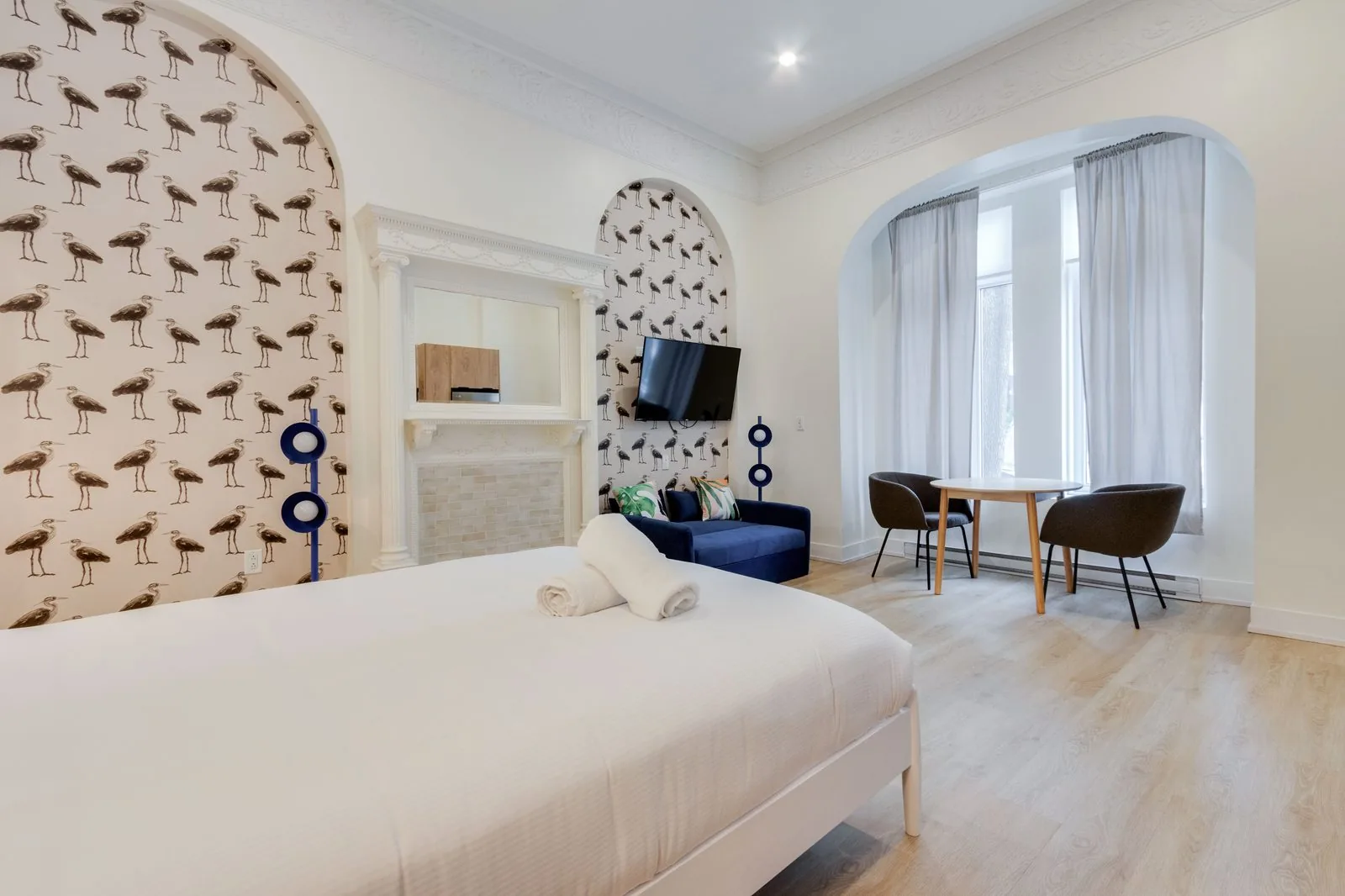
As occupancy climbed, the revenue improvement created a reinvestment opportunity. Each redesigned room was briefed around a distinct visual identity. The heron suite, the checkerboard studio, the snake room. Rooms guests describe, photograph, and return to.
"The renovation wasn't funded by outside capital. It was funded by the revenue growth that preceded it. The optimization paid for the upgrade. The upgrade accelerated the optimization. That's what alignment looks like when it compounds."
— Jason Baxter, Founder, Marketics
Marketics took over the listing in April 2025. The property had been operating at 43% occupancy, competing as a generic hotel room on a platform that rewards experience and identity. The listing was repositioned, the photography rebuilt, the algorithm signals restructured.
By May 2025 (the first full month under Marketics) the property produced $121,000 CAD. Summer followed with sustained months in the $200,000+ range. October matched May. The seasonality curve that had been killing the hotel began to flatten.


The renovation came next. Funded entirely by the revenue growth that preceded it. The Paris-poster room became the heron suite, the checkerboard studio, the snake room. Rooms guests photograph, describe in reviews, and return to. The algorithm rewarded every one of those signals.
This hotel lifted occupancy from 43% to 80% through a full product redesign, with compound gains across two straight years. Across the Marketics portfolio the median lift is 45%, net of market movement. Results are property-specific; every property is audited before a target is set. This engagement is documented and available on request.
Two Disasters. Zero Collapse.
January 2026: a guest incident caused water damage to multiple rooms. Half the property was taken offline. February 2026: a pipe burst forced the hotel to close for nearly two weeks. Two consecutive months of major operational disruption. Rooms offline, staff redirected, revenue constrained by physical capacity rather than demand.
Here's what didn't happen: the algorithm didn't punish them. The position built over eight months of optimization held through both events. Review velocity, response rates, listing signals. Everything Marketics had built continued operating while the property physically couldn't. January 2026 with 50% of rooms closed matched January 2025 with a full property. February 2026 with a two-week forced closure beat February 2025 by 55%.
Not because demand was higher. Because the position was stronger.
"The algorithm doesn't care about your pipe burst. It cares about your signals. We had spent eight months building signals that could survive an interruption."
— Jason Baxter, Founder, MarketicsJanuary 2026
February 2026
despite closure
When It Came Back, It Didn't Recover. It Surpassed.
March 2026 was the first fully operational month after two consecutive disruptions. It produced $114,000 CAD: nearly three times what March 2025 had produced under the same seasonal conditions. April followed at $115,000 and climbing. May forward bookings are already at approximately $180,000 against $121,000 actual in May 2025. Running 49% ahead of the prior year with weeks still to book.
This is what algorithm compounding looks like in practice. Year 1 built the position. Q1 2026 stress-tested it. Spring 2026 is running on top of both. When September and October 2026 arrive (months that historically mirror April and May in this market) the hotel that was heading to foreclosure in early 2025 will be producing $100,000+ CAD in what used to be its slowest season.
vs. $42K March 2025
and climbing
vs. May 2025 actual
*All figures in Canadian dollars. Jan 2026: 50% capacity due to guest water damage. Feb 2026: property partially offline due to pipe burst (~14 days).
Optimization Is Operational Insurance.
Most boutique hotels approaching Airbnb are making the same mistake this one was: treating the platform like a booking channel when it's a search engine with a memory. Airbnb's algorithm builds a position over time based on the signals your listing generates. Review velocity, click-through rates, booking patterns, response rates. That position, once built correctly, doesn't disappear overnight when something goes wrong. It holds.
What Q1 2026 proved is that optimization isn't just a revenue strategy. It's operational insurance. When half your rooms go offline, a strong algorithm position means you lose capacity, not ranking. When you come back, you come back to the position you earned, not to the bottom of the search results. If your property has strong physical assets and underperforming digital presence, the gap between where you are and where this hotel is now is almost certainly not the property.
What tier is your property in?
A free audit reads your real comp set and shows the tier you can win, and the gap to it. No retainer. No contract. We earn when you earn.